

From Classroom to Borders
How a Student Team Helped Streamline a UK Border Bottleneck
When a team of International Relations students began their Master's at Loughborough University, they quickly found themselves working on a pressing Department for Transport (DfT) challenge: how do you keep the Port of Dover moving smoothly as the EU's Entry/Exit Scheme changes border processing?
Keeping a Vital Gateway Moving
The Port of Dover is Britain's busiest ferry port. With the EU Entry/Exit Scheme set to introduce biometric enrolment requirements for non-EU nationals, the Department for Transport needed practical ideas to help the system stay resilient if processing times increase.
The challenge brought together multiple moving parts. Existing disruption plans focused heavily on freight, including arrangements to manage lorry traffic on the M20 during major incidents (Operation Brock). Passenger vehicles were a different case. The key question became how travellers could be supported with clear, timely information when conditions change quickly. Ferry operators can contact their own customers, but traffic authorities and the port have more limited ways to reach passengers directly with real-time guidance about delays, options, and what to expect.
That was the brief handed to students Edward, Ben, Harvey and Naia when they started the Hacking for Transport module, a university module developed to solve the toughest government problems.
Finding the Right Focus
"I honestly had no real idea what the task would be like," Edward admits. "I knew we'd be given a problem statement and that's all I knew really going in."
The team's first ideas were focused on infrastructure. More capacity, improved layouts, upgraded junctions. But as they engaged stakeholders through Beneficiary Discovery interviews and secured a site visit to Dover, their focus pivoted quickly.
"That was the light bulb moment," Edward says. "We saw that the current system in place does operate. The system is fine. The reason we'd been given this problem statement is because of the new European Entry/Exit Scheme that was going to come into place."
That insight gave the project real momentum. The goal was to help a working system stay effective under new conditions.
So, they changed direction completely, moving towards communication and coordination: how to get the right information to passengers at the right time, using smarter and more technology-enabled approaches. The students divided up the work, with taking the lead on working closely with Kent County Council, others exploring the geography and movement patterns around the crossing, and another student led the communications idea.
Real-World Traction
Their final proposal focused on practical ways traffic managers could communicate more directly with passengers during disruption, helping people make better decisions and easing pressure on the network.
"We were actually invited to the Department of Transport to do it again," Edward recalls. The team's work had caught the attention of personnel within DfT who wanted to showcase to senior leadership what the student team had achieved. That second presentation put the team in front of major decision-makers: the Minister for the Future of Roads, the DfT Permanent Secretary, and other senior officials.
Then came the feedback that made the impact feel tangible. "We were told that what we proposed is in the review of official policy, which is pretty amazing."
For a ten-week student project, that level of policy relevance is exceptional.
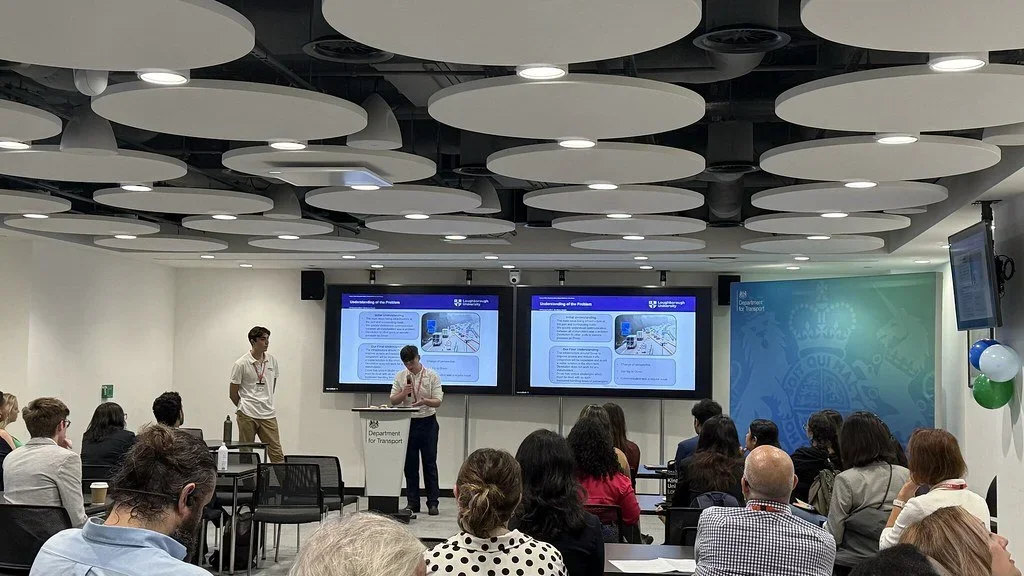
Two of the students presenting at the Department for Transport Student Showcase in September 2025.
Skills that Carry Forward
Edward describes the experience as a genuine step up from typical groupwork as it demanded a professional rhythm: dividing responsibilities, managing stakeholder conversations, and turning insights into clear recommendations.
"It was definitely the most intense teamwork thing I've had to do," he says. "With this, you did have to allocate the work accordingly."
The team delivered effectively and Edward credits the project with building skills that translate directly into careers: outreach, analysis, stakeholder communication, and presenting with confidence.
The practical value showed up fast. "I had my first assessment centre yesterday," Edward says, "and I really do think this helped me stand out. It's absolutely something amazing you can put down on your CV. It definitely feels like I've got a leg up that I wouldn't have done if I didn't do my Master's."
Lessons Learned
The standout takeaway was learning to stay adaptable when working on real problems.
"The problem wasn't set in stone. It will naturally evolve. You learn how to outreach and communicate with people, which I didn't have before."
Edward also came away with a clearer understanding of how innovation in government often works: through collaboration, evidence, and practical testing. The hands-on experience of interviewing stakeholders, visiting sites, and working with civil servants gave him insights no classroom could replicate.
"It's interesting to see how they operate and how things go," he reflects.
His advice is straightforward: commit to the process, engage early with stakeholders, and stay open to changing direction as you learn more.
Want to get involved in our Hacking for programmes? Get in touch at info@commonmission.uk